
Home / Services / Asset Management / Asset Tagging

Asset tagging is the process of fixing a unique, scannable label — a barcode, QR code or RFID tag — to every fixed asset your business owns and linking it to a record in your fixed asset register. Calculate Capitals delivers complete asset tagging services across Dubai, Abu Dhabi, Sharjah and the wider UAE: we survey your sites, tag every asset, reconcile it against your books and hand over a clean, audit-ready register with tracking software.
Most companies in the UAE start asset tagging when an audit, a VAT or corporate tax review, a merger or an office move exposes that the fixed asset register no longer matches what is on the floor. Our team handles the whole job so your staff don’t have to: from designing the tag numbering structure to physically labelling laptops, furniture, machinery, vehicles and IT equipment, and reconciling every item against your general ledger.
| Tag type | Best for | Read method |
|---|---|---|
| Polyester barcode labels | Office furniture, IT equipment, low-cost assets | Handheld or mobile scanner |
| QR code tags | Assets staff check in and out with a phone | Any smartphone camera |
| Anodised aluminium / metal tags | Machinery, outdoor and high-heat assets | Scanner, tamper-evident |
| Tamper-evident VOID labels | High-value or portable assets | Scanner, shows removal |
| UHF RFID tags (incl. on-metal) | Warehouses, hospitals, large sites, fast audits | RFID reader, no line of sight |
Real estate and facilities management, hospitality and hotels, healthcare and clinics, schools and universities, government entities, retail chains, logistics and warehousing, construction and oil & gas contractors.
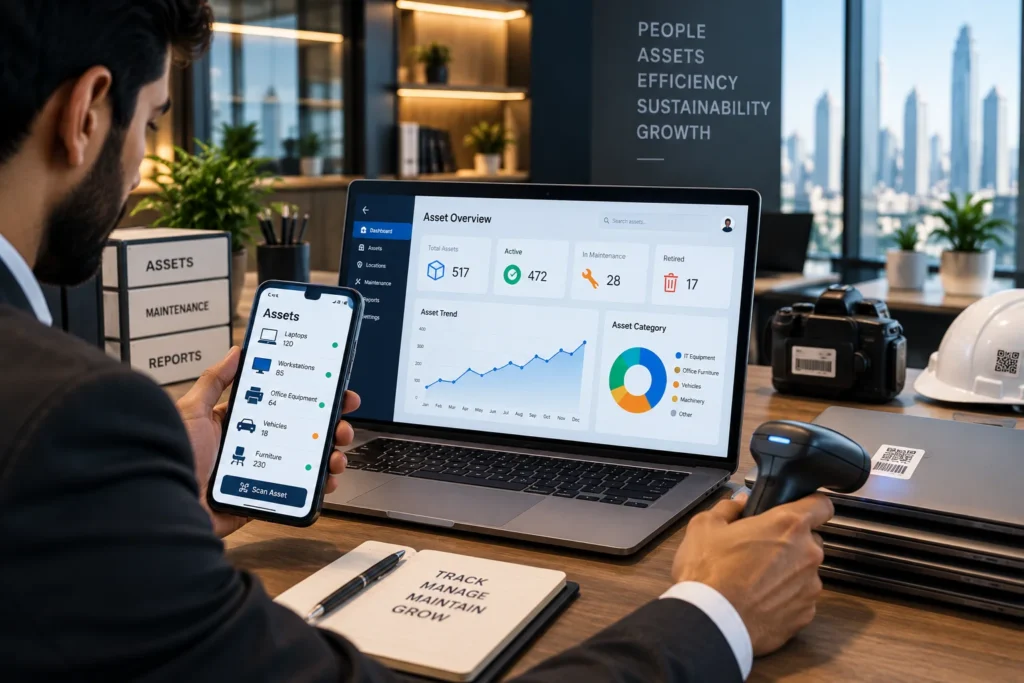

Every asset tagging project covers the full cycle, from the first site walk to a reconciled register your auditors can rely on.
Most tagging vendors stick labels and leave. We are a software and systems team, so tags, register and tracking software are delivered as one system — and the data stays correct after the project ends.
Asset counts, tag types and cost agreed before work starts
Tagging after hours or by floor so your teams keep working
Register reconciled to your ledger with a clear exception report
Scan, move and audit assets from a phone after handover
Tell us how many assets and sites you have, and we’ll send a fixed quote for asset tagging within one working day.




Operations leads and founders on the software we built and what changed afterwards.

Operations Manager
"The entire ERP transition was seamlessly handled. They took the time to understand our workflows and made sure the system was a perfect fit for how we operate"

Marketing Director
"We were counting stock by hand across four sites. Two months after go-live, our warehouse team stopped reconciling spreadsheets entirely."

Managing Director
"They customised the CRM we already owned instead of selling us a new one. That single decision saved us a year of migration work."

Founder
"Fortnightly demos meant no surprises. We saw the app taking shape every two weeks and launched on the date they gave us in week one."
Practical notes on tag types, register structure and running faster asset audits in the UAE.
Asset tagging is fixing a unique barcode, QR or RFID label to each asset and linking it to a record in the fixed asset register, so every item can be identified, located and audited quickly.
Each tag carries a unique ID. Scanning it with a handheld scanner, phone or RFID reader pulls up the asset record — description, location, custodian, cost and condition — and logs moves or audits.
Barcode and QR tags are low cost and suit offices and IT equipment. RFID tags cost more but can be read without line of sight, which makes audits of warehouses and large sites far faster. Many clients mix both.
Pricing depends on the number of assets, tag type, number of sites and whether register reconciliation is included. We give a fixed per-asset or project price after a short survey.
Yes. We plan tagging floor by floor or outside working hours, and most offices are tagged without any downtime.
Yes. Every project ends with a reconciliation against your books and an exception report listing missing, unrecorded and duplicate assets.
WhatsApp us